
Best Practices for Carton Flow Rack in Pick Modules and Packout Zones
SOLUTIONS
FOR THE TOUGHEST APPLICATIONS
"*" indicates required fields
How to Prevent Box Shifting and Improve Flow Performance for Stacked Inventory
Designing a carton flow system for a pick module or packout zone comes with its own set of challenges — and when that inventory is stacked, things get even trickier. Stacked boxes don’t just need to flow; they need to do so without tipping, shifting, or lunging over the pick face.
Pick modules are multi-level racking systems that combine storage solutions, such as pallet flow and carton flow, to streamline order selection. Pallet flow can be used for full-case picking in the pick aisle and/or for reserve storage above. Carton flow is used within the pick aisle for split cases and eaches of high to medium-turn stock. Meanwhile, packout sta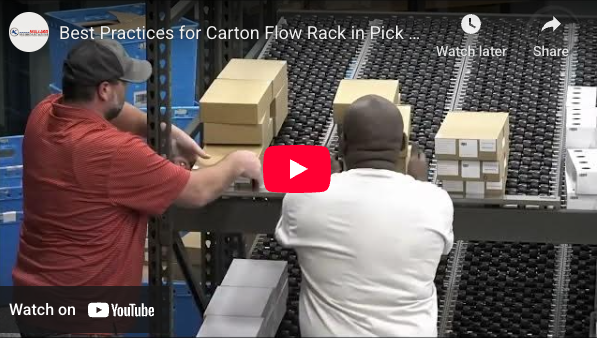 tions serve as the final stop in order processing — often using carton flow to organize and deliver tote-based inventory directly to packers.
To solve both challenges for one of our retail manufacturing customers, the Mallard Engineering Test Lab ran a series of tests using our Dyna-Flo HD carton flow rack. The goal? Optimize flow performance for both their picking and packing activities.
From pitch adjustments to the strategic use of skid plates, the tests revealed the most effective configurations to control product speed, maintain lane integrity, and protect inventory at the point of pick.
If you’re working with stacked inventory or tote-based flow in your carton flow rack, this is the Best Practices Guide you’ve been looking for.
Testing Setup: Pick Module with Mixed-Size Stacked Boxes
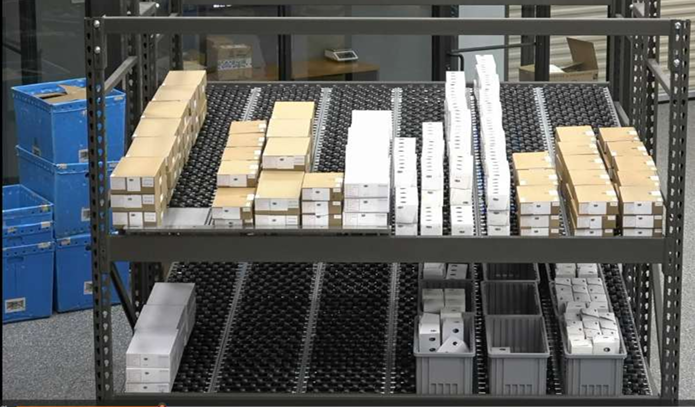
To simulate real picking conditions, we ran a test using a carton flow rack outfitted with (6) x 16” wide Dyna-Flo HD flow tracks per level, set with 2″ wheel centers for consistent contact.
The test evaluated:
- Boxes loaded solo and in stacks of two or three
- Two pitch levels: 1” per foot (right three tracks) and ⅞” per foot (left three tracks)
- Skid plates installed at the end of the last two tracks:
- 12″ deep (left)
- 6″ deep (right)
Mallard skid plates are designed to slow box momentum at the pick face, preventing lunge and product damage. Made from durable steel with a beveled edge, they’re securely bolted to the rack for safe, reliable performance.
Best Practices: Stacked Boxes on Carton Flow Rack
1. Examine the boxes
- Check for box overhang or uneven bottoms that could affect contact with the wheels and slow or hinder flow.
- Ensure boxes are sturdy enough to flow without conforming to the wheeled tracks.
- Confirm the combined weight of the inventory is within the capacity for the carton flow shelf. Dyna-Flo HD has a capacity of 50 lbs per sq. ft. within 8 ft. of unsupported length.
2. Test the Pitch
- In this test, the 7/8″ per foot pitch outperformed the 1″ per foot setup.
- Ideally, a slower, more controlled flow helps reduce jostling and tipping of top boxes.
3. Consider Skid Plates to Control End-of-Lane Speed
- In this test, the 12” deep skid plate + 7/8″ pitch combo delivered the best results. The 6” skid plate was not deep enough to slow boxes effectively.
- Skid plates prevented box lunge, especially in stacked box tests.
- Test different lengths of skid plate to find the ideal size for your inventory specs.
- Bevel the edge to prevent the plate from catching the box edge.
4. Plan for Restart Methods
- Minimal restart issues were observed in this test.
- Typically, hang-ups in carton flow are easily resolved by gently pushing back on the front cartons to restart the rear inventory flow, or by simply loading another box into the lane.
Packout Station Testing: Tote-Based Carton Flow Rack

The second round of testing focused on the packout area, where the previously picked boxes arrive in totes. The carton flow rack consolidates and stages the completed order components for packing.
The objective was to ensure consistent flow and accessibility for two common tote sizes:
- Small tote: 11″W x 17″L x 8″H
- Large tote: 20″W x 24″L x 18″H
Both tote types were tested using the same Dyna-Flo HD flow tracks, but with different vertical spacing (measured top-of-beam to top-of-beam) to ensure clearance:
- 15” TOB-to-TOB for small totes
- 27” TOB-to-TOB for large totes
Each tote lane also includes a 15” long tilt tray at the front. These angled trays help the front tote glide forward slightly, making it easier for workers to either reach inside for individual order components or lift the entire tote without reaching deep into the rack. Tilt trays can also be adjusted to improve ergonomic positioning and reduce strain.
Results:
- Smooth tote loading and unloading
- No flow disruptions
- The 2100 lb shelf capacity supported both tote sizes without issue
Final Recommendations: Pick Module & Packout Carton Flow Setup
Whether you’re outfitting a busy pick module or optimizing a packout area for speed and safety, here’s your quick-hit guide to carton flow success:
✔ Compare pitch options to find optimal flow control
✔ Consider skid plates at the pick face for optimal control
✔ Secure skid plates with bolts to prevent shifting under load
✔ Verify vertical clearances based on carton stack and tote heights
✔ Consider adding tilt trays to improve accessibility to the cartons & totes
Gravity Flow Rack Support Just a Click Away

No two warehouse applications are the same. That’s why Mallard offers product and design support… plus our state-of-the-art interactive test lab to ensure your gravity flow systems perform as needed from day one.
Contact the Gravity Flow Experts. Let us help create a solution that performs for your team.
