
Best Practices for Using Pallet Flow Rack with Super Sacks & Winged Pallets
SOLUTIONS
FOR THE TOUGHEST APPLICATIONS
"*" indicates required fields
More Than a Wing and a Prayer… Ensure Safe, Consistent Flow for Cargo Pallets in Gravity Flow Rack
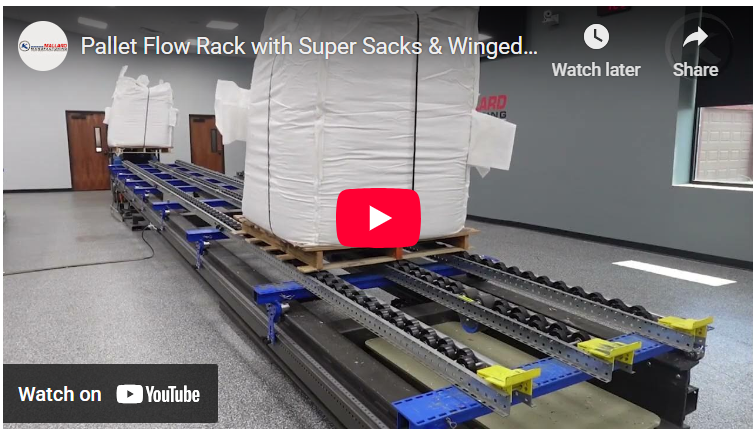 Handling super sacks in a warehouse environment can be tricky, especially when paired with non-standard “winged” cargo-style pallets. These loads are not only heavy—over 2,000 lbs each—but also rely on a very specific design that demands careful pallet flow rack engineering and lane configuration.
To ensure optimal performance, the Mallard engineering team conducted in-house testing on two pallet flow lane designs using customer-supplied pallets and inventory. Testing with real-world materials allowed us to simulate actual operating conditions and identify the most effective solution.
The testing delivered valuable insights our team is excited to pass along—practical strategies to help you get consistent, reliable pallet flow, even when working with tricky or non-standard pallet designs.
Understanding the Challenges of Winged Pallets
When designing a pallet flow rack system, it’s essential to understand how the pallet interacts with the lane—especially when working with a pallet style that can present a true make-or-break design challenge.
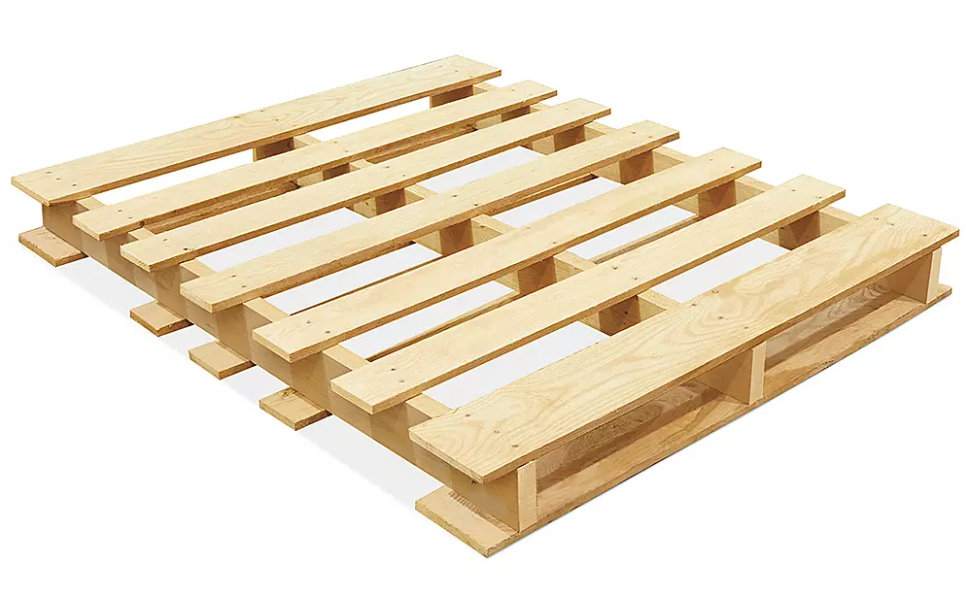
What Are Winged Pallets?
Winged pallets are a type of wood pallet where the top and bottom deck boards extend beyond the stringers—the internal structural supports that bear the load. This design allows for a slightly larger surface area but introduces a significant vulnerability: the overhanging deck boards have no structural support underneath.
Why It Matters in Gravity Flow Rack Design:
Typically, a pallet flow lane is designed based on the pallet’s overall size, including any inventory overhang. In this scenario, if the pallet flow lane were built to the full width of the pallet, the outside rails would contact the underside of the overhanging deck boards—components that lack internal support. To avoid this, the lane must be narrowed so the outside rails align directly with the stringer boards, where the load is adequately supported. If excessive pressure is applied to the unsupported deck board extensions, the boards can crack, resulting in hang-ups and interruptions to the flow.
That means:
- Pallet flow lanes must be narrowed to ensure the outer rails make direct contact with the pallet stringers, not the overhanging deck boards.
- Rail placement must be precise to prevent damage and maintain load stability.
- Poor pallet condition (e.g., cracked boards, protruding nails) can increase the risk of hang-ups and should be factored into system design.
- Centering and tracking are critical, especially in 3-rail wheeled systems, to ensure the stringers remain aligned with the rails throughout flow.
- Speed controllers and proper rail configuration can help maintain flow integrity even when pallet conditions vary.
For this test, many of the sample pallets were in poor condition, including broken or cracked boards, uneven board thickness, protruding nails, and separated deck boards. Despite those issues, the properly designed gravity flow rack lane (D/D/D configuration) was able to consistently center and control the pallet, ensuring smooth flow and safe unloading.
Testing Winged Pallets & Super Sacks in Gravity Flow Lanes
The pallet dimensions were 45″ x 45″, with loads standing 52″ tall and weighing approximately 2,050 lbs each. Several of the sample pallets were in poor condition, including broken or cracked boards, uneven board thickness, protruding nails, and separated deck boards—making the test a realistic simulation of actual warehouse conditions.
Two Lane Configurations Tested
The Mallard engineers tested two different 3-rail wheeled pallet flow rack designs to determine which configuration offered the safest, most consistent performance: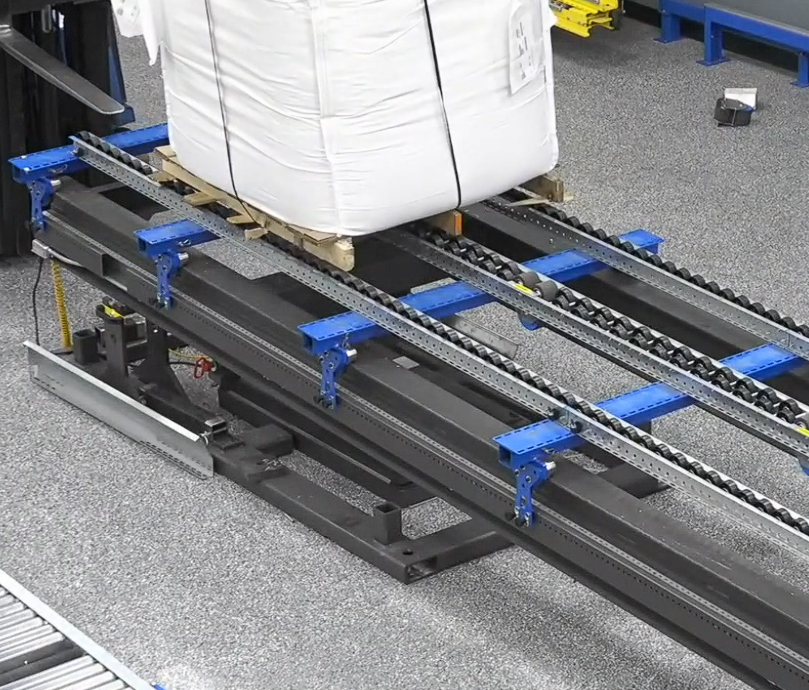
1. S/D/S Configuration (Single Rail / Double Rail / Single Rail)
This setup used a single wheel rail on each side and a double rail in the center.
- Results: Pallets were able to flow down the lane, and the drop-in speed controllers effectively managed descent speed. However, some damaged pallets caused hang-ups within the lane.
- Resolution: For most pallets, operators were able to re-engage flow using the plugging method, and by loading another pallet into the lane to push the lead pallet forward. Customers are instructed to avoid putting pallets with broken or missing boards into the flow lanes.
((Photo Caption: Missing Bottom Boards Restrict Flow ))
2. D/D/D Configuration (Double Wheels on All Three Rails)
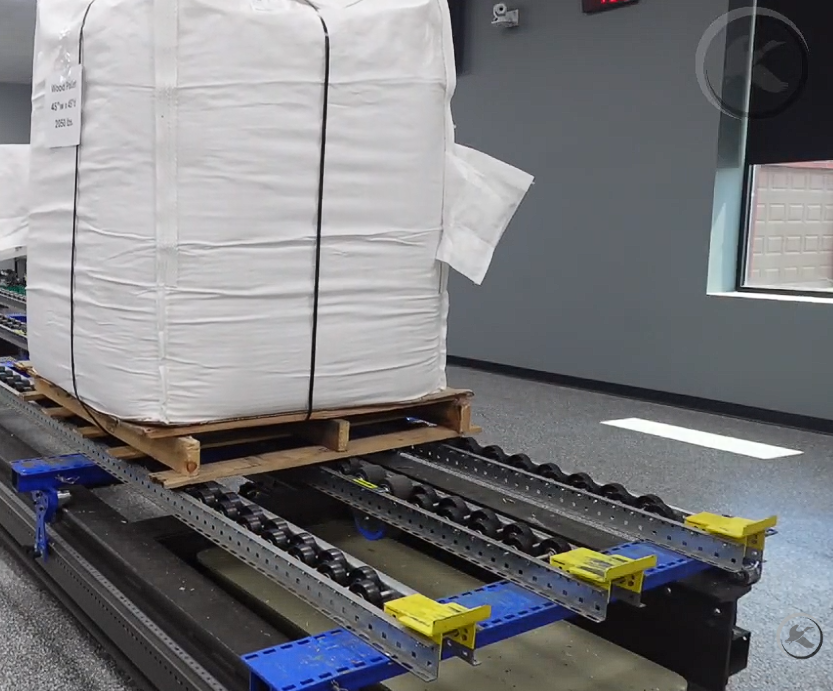
More Consistent Flow & Restart
This configuration used double wheel rails on both outside edges and in the center of the lane.
- Results: This design provided more even support and better alignment with the stringers of the winged pallets. Flow performance was smoother overall, with fewer instances of hang-ups.
- Note: A brief stoppage occurred during unloading, but the pallet restarted on its own without operator assistance. Any similar minor interruptions can also be resolved with standard plugging methods.
Key Takeaway:
The D/D/D configuration proved to be the better option for this application, offering more consistent flow, improved pallet centering, and better support for damaged or irregular pallets.
Engineering Insight: Drop-in speed controllers were installed every 56″ to ensure pallets made contact in each pallet position within the lane. This not only controlled descent speed but also helped maintain pallet alignment, keeping the stringers properly positioned over the support rails.
Engineering Insights & Best Practices
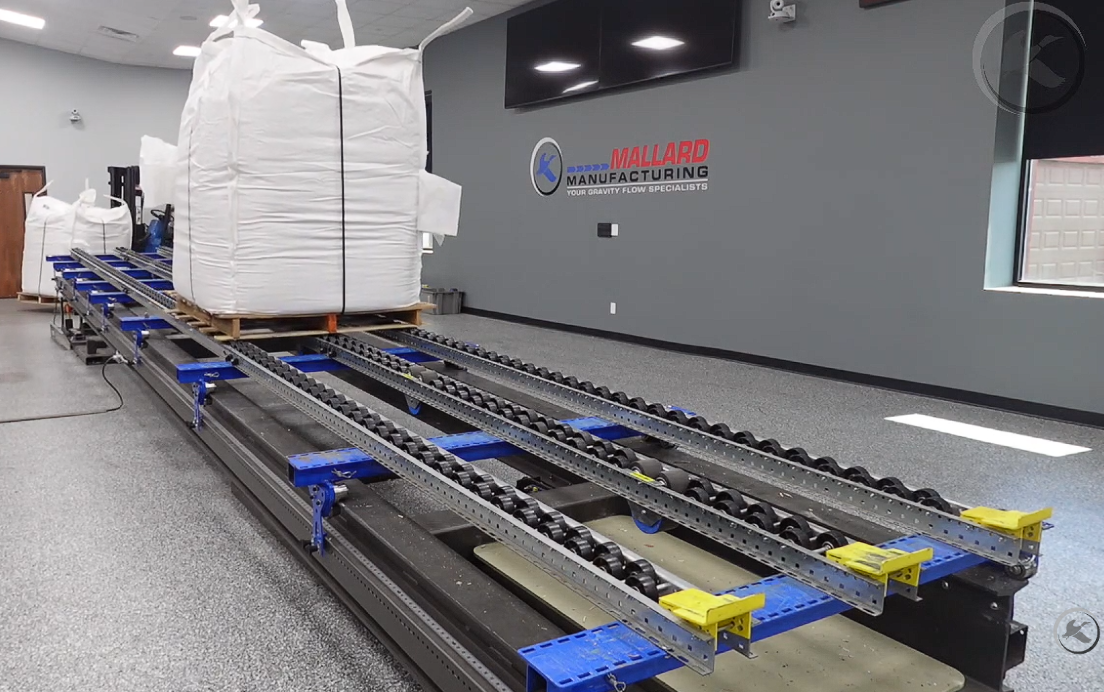
Testing confirmed that both configurations flowed with the help of drop-in speed controllers, but the D/D/D rail layout delivered more consistent support and smoother unloading—especially with damaged winged pallets. Any minor hang-ups were easily resolved using the plugging method to re-engage flow.
Best Practices to Apply:
- Design lanes to support the pallet stringers, not the overhanging deck boards
- Install drop-in speed controllers at intervals that manage speed and maintain alignment
- Train operators on the plugging method to manage occasional hang-ups
- Inspect pallet condition—damaged pallets reduce system performance and can cause flow disruptions
Custom Solutions Matter
No two pallet flow applications are the same—especially when dealing with non-standard pallets or load types like super sacks. Mallard’s in-house engineering and testing ensure that your gravity flow rack system is designed to meet the real demands of your operation, not just theoretical specs.
Did You Know? Mallard offers in-house testing to validate flow lane design before finalizing your order to ensure reliable performance from day one.
The right pallet flow rack design can transform even challenging loads—such as super sacks on winged pallets—into a smooth, reliable operation.
Contact our team for design and testing support.
Related Content:
Learn more about your pallet design and flow rack considerations in our blog: Everything About the Pallet.
