
Full & Split-Roller Pallet Flow Rack Design Tips | Mallard Best Practices – Part 2
SOLUTIONS
FOR THE TOUGHEST APPLICATIONS
"*" indicates required fields

Split-Roller Pallet Flow – 5-deep, Drum Roller Speed Controllers, 3000# loads
The Mallard gravity flow experts are back with more tips to directly address systems design and applications for split-roller, full roller, and even combo roller rack flow lanes. Last year we published a Best Practices blog discussing the basic differences between the roller rack systems, and now we are back to drill down a bit deeper and address additional common questions we’ve been fielding from our customers.
A Roller Rack Recap –
Full & Split Roller Specs
- Roller diameter options – 1.9” & 2.5”
- Axles – 5/16” bolt, 7/16” hex
- Capacities – 260 lb. – 350 lb. per roller
- Between frame dimensions – 4”- 60”
Full & Split-Roller Pallet Flow Defined
- Full Roller – single roller lanes allow for varied pallet sizes and inventory changes easier than other system configurations.
- Split Roller – configured with 3 rails of 6” rollers or 3 rails of 12” rollers. Recommended for heavy pallet loads of 2500 lbs. or more. Use with same-sized pallets
What Do Full & Split-Roller Have in Common?
- Rollers compatible with plastic, metal, corrugated, slip & non-standard pallets
- Galvanized rollers are washdown compliant and rust-resistant
- Engineered using heavy-duty bearings, axles, tube, and side-channel
- Low-maintenance and easy to repair if damaged
- Can be equipped for case picking from pallet flow
Parting Ways – When Do You Want to Use One over the Other?
In many cases, the preference is just that, a preference. Maybe forklift access is considered easier with split-roller, or one system is more budget-friendly than the other, but there are times when it’s important to choose split-roller vs full, and vice-versa.
Always start with the basics – the pallet. Pallet load weight and pallet style will often dictate which lane design is most effective. Examine the bottom of the pallet. Are there feet, or steel runners, for example? Perhaps you’re using a slip sheet? The pallet style will often dictate the composition of the pallet flow lane.
Split-Roller Pallet Flow
- Pallet loads exceeding 2500 lbs. – excessive pallet weights must go to split roller where the rails can be configured to safely balance the loads and minimize pallet conformity under the load weight.
- Pallets with pod feet, steel rails, or a completely flat surface are also typically better served on split roller where the rails can be positioned to provide direct contact with the rollers to keep the pallet moving down the lane.
- Loads that are smaller than or exceed standard pallet dimensions – the flexibility to strategically position the rails benefits large and small loads.
- Case pick from deep-lane pallet flow with the FS-201 pallet separator
- Floor-mounted applications – push-assisted and pitched
- Oversized inventory – support bulky inventory during intake with split-roller pallet flow. Minimize driving and dock congestion.
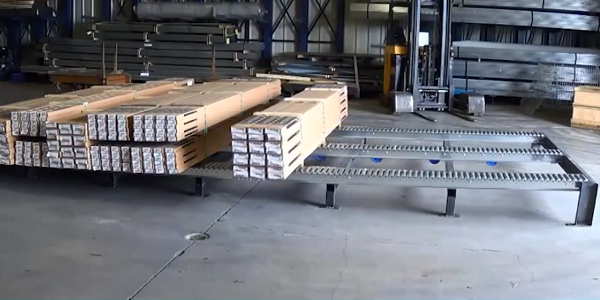 Floor-Mounted Split-Roller for Oversized Loads |
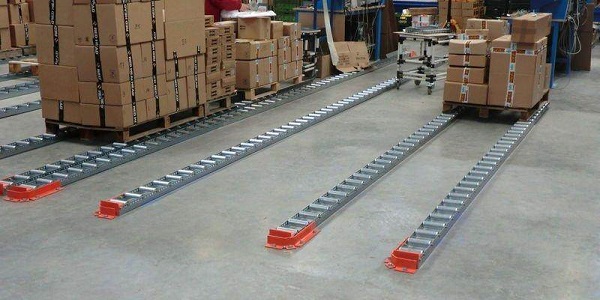 Floor-Mounted, Push-Assisted Split-Roller |
Full-Roller Pallet Flow
- Non-GMA-style pallets (plastic, metal, non-wood) – non-standard pallets flow more consistently with greater surface area contact, except where heavy loads can cause pallets to conform to the rollers.
- Pallet loads with a range of load weights – typically, the pallet load weights should be similar per lane, but full-roller can sometimes safely accommodate a variance in load weight and pallet style. The lane must be configured to handle the heaviest pallet load. We recommend testing the lane and the pallets in the Mallard Engineering Testing Lab before settling on a lane design.
- Case pick from deep-lane pallet flow with the FRFS-202 pallet separator

Full Roller Pallet Flow with Ramp Stops
Special Applications
Case Picking from Pallet Flow
If you are using the pallet flow lanes for case picking, first of all, may we say… Good choice! Pallet flow is a highly efficient pallet solution for high-density case picking; however, you will require a pallet separator in the lane to eliminate the back pressure. Our Flex separator will make it easier, faster, and safer for your workers to remove empty pallets from the lane. The FS-201 is designed to fit a split-roller pallet flow lane, and the FRFS-202 fits right within full-roller pallet flow. See our brochure for system specs and additional details.

Split-Roller Case Pick to Conveyor
Combo Full & Split-Roller Pallet Flow Lanes
There are occasions where a combination lane is beneficial. Configuring your flow lane with full roller rack that transitions to split-roller can serve as impact protection in heavy load applications. Alternatively, split-roller can transition to full roller in pallet building applications. Just add the case pick separator to the load (charge) end of the lane to hold the pallet in place until loaded, then it can be released to flow on full roller to the opposite side for extraction. Combo lanes can be more economical in some instances and, again, depending on pallet and load specs, the configuration may be necessary for controlling pallet speed and tracking. For support in configuring a “combo” lane, we suggest contacting our gravity flow experts.
Full-Roller with Ultra-Grip Speed Controllers Leading to Split-Roller with Forklift Separator
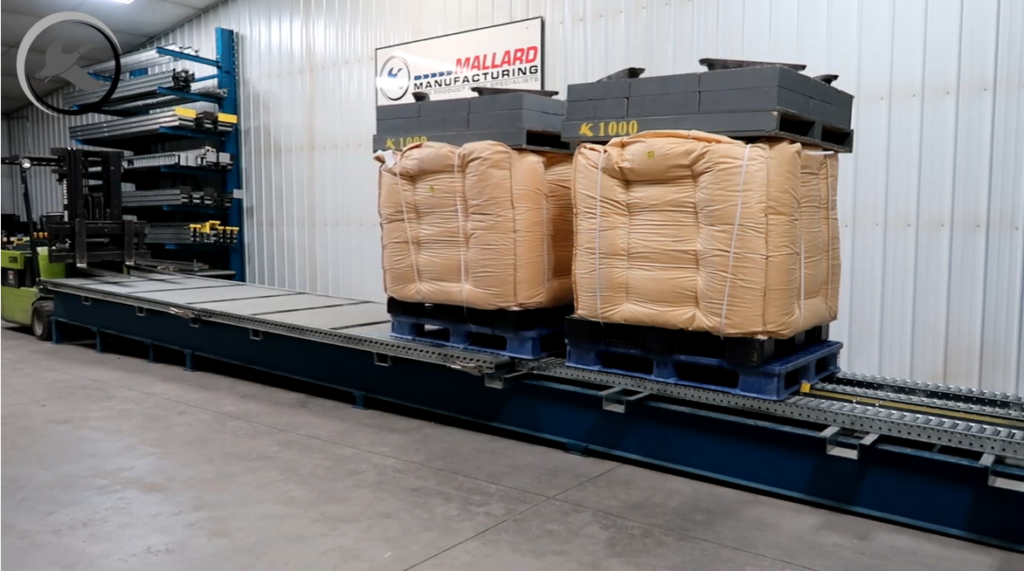
Full-Roller with Ultra-Grip Speed Controllers Leading to Split-Roller with Forklift Separator
Speed Controllers
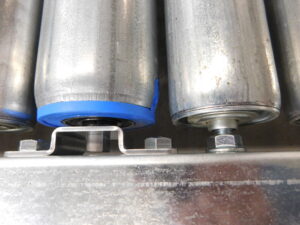
Drum Controller Full Roller Pallet Flow
It’s often important in a pallet flow lane to add speed controllers to the whole lane or sections of the lane to control the speed and tracking of the pallet. Mallard offers several speed controllers that are designed to work with the type of pallet and load. Full and split-roller options are as follows:
Drum controllers – mount in both full & split-roller right within the rails. They have a galvanized finish and serve to slow the pallets and control the tracking down lane.
Drop-in speed controllers – mount in split-roller within the rails. They are rubber-surfaced and make direct contact with the pallet, which is particularly useful with plastic and metal surfaces that can otherwise surf over the galvanized rollers.
Ultra-grip rollers with indirect mount speed controllers – this is a one-two combo for full-roller pallet flow that is very effective. The Ultra-Grip rollers are rubber coated and mounted in pairs, flush within the lane. The rubber surface makes good contact with the pallets. In addition, indirect mount speed controllers are mounted directly underneath to control the rotation of the Ultra-grip rollers and slow the pallet.
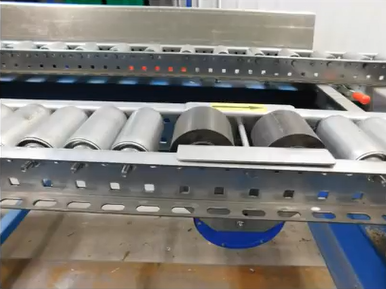 Drop-In Speed Controller in Split Roller |
 Indirect Mount Speed Controller with Ultra-Grip Rollers |
Where to Go for Help
Full-roller and split-roller pallet flow offer a variety of benefits for your busy warehouse or distribution operations. Let our gravity flow experts help configure the solution that meets all of your needs. Call our team for design ideas, testing, and a quote.
Learn more about full & split-roller pallet flow racking:
